
Abstract
U.S. health insurance is complex, and inadequate understanding and limited access to justice have dire implications for the most vulnerable. Advances in natural language processing present an opportunity to support efficient, case-specific understanding, and to improve access to justice and healthcare. Yet existing corpora lack context necessary for assessing even simple cases.
We collect and release a corpus of reputable legal and medical text related to U.S. health insurance. We also introduce an outcome prediction task for health insurance appeals designed to support regulatory and patient self-help applications, and release a labeled benchmark for our task, and models trained on it.
Introduction
Health insurance coverage issues in the U.S. pose serious problems for patients. They cause delays, forgone care, and detrimental health outcomes. Sometimes patients receive services despite denials, incurring bills, debt, and collections lawsuits. For the most vulnerable, there are calamitous effects (Collins et al., 2023; Lopes et al., 2022; Pollitz et al., 2023).
Evaluating coverage rules requires precise understanding of a complex web of case-specific laws, contracts, and medical literature. In cases where existing automation does not exist, fails, or is disputed, specialists such as medical coders, pharmacists, doctors, and attorneys do such work manually. The processes are time-consuming and error-prone, and successful navigation often involves tasks like synthesis of medical literature and contracts.
Advances in natural language understanding (NLU) present an opportunity to improve patient outcomes. In particular, extractive and generative models can increase the efficiency with which specialists understand cases. Tools that support efficient and accurate coverage understanding stand to serve patients, caseworkers, and regulators alike. They can lower unnecessary administrative costs, and improve both health and financial outcomes.
However, there are barriers preventing responsible and effective use of such tools. Most notably, there is a dearth of high-quality, curated corpora containing information sufficient to correctly answer coverage questions.
We make four contributions. First, we collect and release a corpus of text that informs understanding of health insurance coverage rules. Second, we present an 'appeal adjudication' task. Third, we curate and release an annotated dataset to serve as a benchmark for the task. Finally, we train, evaluate, and release baseline models using our benchmark.
The datasets and code for all of our contributions have been made publicly available1 under a permissive license. This work was previously accepted and presented as a workshop paper at the AI for Access to Justice workshop at JURIX 2024.
Acknowledgements
It is my pleasure to thank Leigh Thorne for her feedback on the interim annotation guidelines, and Jeanne Alicandro and anonymous referees for providing detailed comments and suggestions on this manuscript.
Related Work
Pretraining Corpora
Domain adaptive pretraining can improve performance on downstream tasks (Gururangan et al., 2020; Zheng et al., 2021). High quality pretraining corpora for both legal and medical applications abound.
In the legal domain, there is a rich history of pretraining models via masked language objectives (Chalkidis et al., 2020, 2023; Elwany et al., 2019; Henderson et al., 2022; Niklaus et al., 2023; Niklaus & Giofré, 2022).
The medical domain shares a similar history (Alsentzer et al., 2019; Chen et al., 2023; Gu et al., 2020; Huang et al., 2019).
Recent years have seen an increasing focus on using language models to support arbitrary downstream tasks (e.g. (Niklaus et al., 2024; Niklaus & Giofré, 2022)). For tasks involving complex domain specific context, high quality pretraining corpora are critical. This is especially true for legal and medical question answering.
Our corpus shares some overlap with two existing datasets: Pile of Law (Henderson et al., 2022) and the Guidance dataset (Chen et al., 2023). The overlap can be understood in detail by consulting Appendix A.
To our knowledge, this work is among the first few efforts targeting curation of pretraining data in the intersection of legal and medical domains. The only other works of which we are aware are that of (Hua et al., 2022), which focused on tasks involving personal injury cases, and that of (Aracena et al., 2023) and (Jiang et al., 2023) which involve health insurance coverage tasks.
Supervised Finetuning Data
There has also been a large body of work focused on curating data for specific legal and medical tasks.
In the legal domain, people have developed datasets and models to support entity and clause selection (Hendrycks et al., 2021; Wang et al., 2023), multiple choice question answering (Chalkidis et al., 2021; Zheng et al., 2021b), span-based question answering (Rajpurkar et al., 2018; Ravichander et al., 2019; Uddin Ahmad et al., 2020), extractive summarization (Bauer et al., 2023; Habernal et al., 2022), retrieval (Yu et al., 2022), and document and word level classification (Chalkidis et al., 2019; Tuggener et al., 2020), among other tasks.
In the medical domain, people have developed datasets and models to support multiple choice question answering (Pal et al., 2022), span-based question answering (D. Jin et al., 2020; Q. Jin et al., 2019), document and clause classification (Alsentzer et al., 2019; Huang et al., 2019), and language modeling (Chen et al., 2023; Singhal et al., 2023), among other tasks.
In this work we construct a benchmark dataset for a document classification task. We also describe how to adapt our (pseudo)-annotation pipeline to yield related, but distinct benchmarks.
Case Outcome Prediction Tasks
Our task shares qualities with existing legal judgement prediction tasks (Guha et al., 2023; Malik et al., 2021; Niklaus et al., 2021; Niklaus, Matoshi, Rani, et al., 2023).
In particular, a few tasks presented in recent literature share many similarities.
For example, our task is at a high level the same as that presented in (Aracena et al., 2023). The task there is to predict health insurance coverage outcomes from Spanish language clinical notes. Our task differs in a few critical ways. It is a three class problem, focused on English, and concerned with both expert and layperson descriptions.
Similarly, (Jiang et al., 2023) introduces a general purpose medical language model, and a health insurance denial task. Like (Aracena et al., 2023), it focuses on making predictions from clinical notes. The authors did not release model weights nor training data, so the results are not reproducible. Our work presents a distinct task, and a more open source approach. We have released the training data and code under permissive licenses.
Finally, we note that outcome prediction tasks in the literature are often actually retrospective outcome classification tasks (Medvedeva & Mcbride, 2023). The tasks, benchmarks, and models do not support real world forecasting. Instead, they 'predict' case outcomes from text which is not and could not be produced before adjudication. Our focus is on real world forecasting applications, and our methods reflect that focus.
A Corpus
Our dataset consists of documents from diverse sources. It includes U.S. federal and state law, insurance contracts, official regulatory guidance, agency opinions and policy briefs, official coverage rules for Medicaid and Medicare, and summaries of appeal adjudications. In total, the dataset contains 8,311 documents, 419 million words, and 2.7 billion characters. Uncompressed, it occupies 2.8 gigabytes of disk space.
In the realm of pretraining corpora, this is a small dataset. Our focus in curation was to produce a corpus free from redundancies (which is not often a focus2), and to source text primarily from reputable, authoritative sources. An ultimate aim beyond the scope of this work is to produce a minimally sufficient, authoritative corpus for related adjudication tasks. The dataset is intended to support both pretraining and retrieval.
Composition
We describe the composition of our dataset via a partition into six categories. Each document in our corpus belongs to exactly one of the following categories:
Legal. Current or former U.S. law.
Regulatory Guidance. Guidance on U.S. law, released by agencies.
Coverage Rules, Contracts, and Medical Policies. Text outside formal law that describes binding coverage rules3. This includes text from contracts, and contract-referenced or proprietary medical policies.
Opinion, Policy, and Summary. Opinions, policy perspectives, or summaries of law, proposed law, executive actions, or compliance.
Case Descriptions. Reviews of individual health insurance coverage decisions.
Medical Guidelines and Literature. Clinical guidelines and medical literature, excluding contract-specific medical policy falling into category 3.
For the interested reader we provide a more detailed description of the constituents of the dataset in Appendix A.
Document-Level Tags
We equip each document in our corpus with a set of plain text tags. For example, documents comprised of text from U.S. law carry a "legal" tag. These tags support use as a knowledge base. For example the tags generally support constrained retrieval. This applies in particular to Retrieval Augmented Generation (RAG) (Lewis et al., 2020), where one can use the tags to limit the collection of document chunks considered for injection in a prompt. Exact tag-based filtering supports pipelines capable of providing certain types of performance guarantee.
Partitioning Tags
We formulated a privileged set of partitioning tags, i.e. tags with the property that each document in the dataset belongs to exactly one tag. The privileged set corresponds to the breakdown described in the composition section. The associated plain text tags are: "legal", "regulatory-guidance", "contract-coverage-rule-medical-policy", "opinion-policy-summary", "case-description", and "clinical-guidelines".
Knowledge Base Tag
We also make use of a knowledge base tag ("kb") to indicate that a document is authoritative. This is of course an ambiguous determination. Nonetheless, our goal was to formalize this association as a step toward supporting applications requiring authoritative retrieval.
Knowledge base tags were auto generated during dataset curation with a human in the loop. We tried to assign the tag only to documents which are binding in law, or which constitute legal guidance from government agencies. However, even this characterization is ambiguous. For example, a contract is binding in law for those who are parties to the contract, but not for others. Documents which are binding in law in some but not all contexts, such as contracts, were decorated with the 'kb' tag.
For example, we label all Medicare Coverage Determination documents with the knowledge base tag. This is because law stipulates the authority of these determinations. As a result they hold established and verifiable weight in individual case adjudications.
As a non-example, we omit the knowledge base tag for congressional testimony documents. While such testimony is often reputable, and accurate, it is neither binding nor is it formal administrative guidance.
Example Usage
Consider a caseworker seeking information on coverage rules for a Medicaid beneficiary in New York state. Here a caseworker could mean a pharmacist, nurse, physician, attorney, patient advocate, or other individual who is supporting the beneficiary in understanding and accessing their coverage.
A pipeline can employ filtering to restrict attention to documents with "legal", "kb", "new-york" and "medicaid" tags. This provides a simple and efficient mechanism to deterministically avoid retrieval of irrelevant documents. For example, those corresponding to Ohio state law.
This capability is important for at least two reasons. First, it removes the necessity to filter documents using only their semantic content. This allows for more efficient retrieval, which makes deployment more accessible for low-resource efforts, and improves latency. Second, tag based filtering supports provable guarantees about the relevance of retrieved documents. While the end to end utility of such guarantees in typical generative pipelines is tenuous, the utility in extractive or otherwise guardrailed pipelines need not be.
Tag Distribution
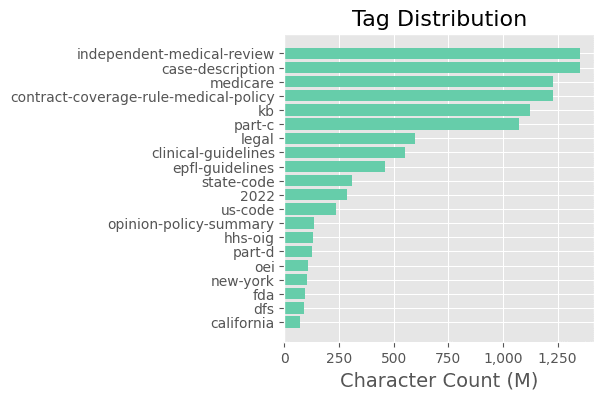
The table below shows high level statistics about the tag distribution. In total there are 616 unique tags used across the 8,311 documents. The figure shows the distribution of tags by associated character count.
| Category | Documents | Words (M) | Chars (M) | Size (GB) |
|---|---|---|---|---|
| legal | 330 | 86 | 545 | 0.57 |
| regulatory-guidance | 1,110 | 5 | 38 | 0.04 |
| contract-coverage-rule-medical-policy | 7 | 196 | 1,228 | 1.31 |
| opinion-policy-summary | 2,093 | 19 | 131 | 0.14 |
| case-description | 2,630 | 214 | 1,351 | 1.44 |
| clinical-guidelines | 2,150 | 82 | 554 | 0.57 |
| [kb] | [1,434] | [171] | [1,123] | [1.16] |
| Total | 8,311 | 419 | 2,703 | 2.83 |
An Appeal Adjudication task
We now introduce an appeal adjudication task, and an associated dataset.
Task Definition
The task is to predict whether an external appeal of a health insurance coverage denial will result in a full or partial overturn, given a description of the denial context and two optional pieces of metadata. We formulate this as a three class classification problem, with classes corresponding to: full or partial overturns, upheld decisions, and insufficient descriptions. We do not require that the description be complete, consist of clinical notes, or be written by experts. The optional metadata specify insurance type and regulatory jurisdiction classifications4 - two factors that influence coverage rules and appeal outcomes.
We define an external appeal to be one submitted to an independent third party. This is in contrast to an internal appeal, which is one submitted to the insurance administrator that issues a denial. External appeal processes exist for most types of health insurance, but vary in nature across them.
Motivation
This task is important for patients and caseworkers engaged in appeals processes. The likelihood of appeal success informs strategy, expectations, and cost-benefit analyses for appellants. It can also help streamline costly administrative work, and inform oversight.
It is important for regulators, who typically want to ensure that external appeal overturn rates are low5. Low overturn rates reflect consistency between insurer and third party adjudication, which is some form of fairness.
We compiled a labeled dataset for this task by exploiting historical case outcomes. Those outcomes are present in the "case-description" subset of our corpus.
Prediction
Although our labeled benchmark dataset is generated from historical case outcomes, we note that we are singularly focused on supporting actual forecasting. That is, we aim to support predicting appeal adjudication outcomes in real world situations in which the outcomes have yet to occur. This means our task must be addressed using only information which would be known by appellants or their advocates at that time. While this goal may sound obvious or implied from our setup, there has recently been critical and justified examination of misuse of the term 'prediction' in legal language tasks that perform classification using information that is not realistically available in the real world settings they purportedly support (Medvedeva et al., 2023; Medvedeva & Mcbride, 2023).
In the following sections we introduce a process for learning to extract subsets of case summaries to obtain context which is reflective of that known by patients prior to their appeals. In this way, our approach to the task is truly one of outcome forecasting, rather than post hoc outcome-based judgement identification, to use the language of (Medvedeva et al., 2023). This is because our process is designed to extract summaries that only contain statements which could be known before an appeal is submitted.
Our focus on this quality of our inputs is central to our formulation, as we are interested in real world use of our models to support patients in accessing coverage to which they are entitled, rather than retrospective classification models tailored to the qualities of review summaries.
Challenges
Our task is difficult for many reasons. Most notable is that outcomes may depend on facts not present in our model inputs, such as jurisdiction, governing law, contracts, medical history, policy, and literature. These vary by state, insured, insurer, and insurance type, and change over time.
This renders our modeling task under specified in many contexts, with no correct answer for many inputs. For example, what should a model predict when an appeal would be overturned under Medicare rules but upheld under New York Medicaid rules, if insurance type isn't specified?
We introduce our task despite this difficulty for three reasons.
First, responsible deployment of a well-performing model would be valuable and pose few risks. Although such a model cannot be perfect, it can help improve access to justice. For some contexts, denials are overwhelmingly inappropriate, across jurisdictions, insurance types, and contracts. It is possible to identify such context as likely to be problematic. This is useful in the same way a prediction for 90% chance of rain (another theoretically under specified forecasting task) is useful. It would be irresponsible to bet one's wellbeing on the prediction, but carrying an umbrella is a relatively harmless precaution. Models that excel at our task can help promote access to justice, without posing risks, if deployed with caution and with limited scope.
Second, we hope this work promotes further research on related tasks. For example, one could extend our benchmark to additionally include optional input metadata encoding medical billing codes.
Finally, our task circumvents a common difficulty for patients: accessing important details. Patients face significant barriers in accessing important details. They may not have full access to contracts or medical records, and may not know who funds their plan. These details are critically relevant in helping patients navigate recourse available to them. Nonetheless, they are often inaccessible, even when law ostensibly protects access. Accurate prediction tools with lower barriers to entry can improve access to justice for those who might otherwise forgo recourse.
It is important to note that our task differs from that performed by adjudicators. Reviewers rely on charts, notes, diagnoses, and rationales, and can request more information. Our benchmark descriptions provide only brief explanations which are always insufficient for adjudication, and sometimes also insufficient for high quality outcome forecasting.
Some explanations in our benchmark are too general to hold any predictive power. For example, a summary might say "My hospital stay was denied". There are many reasons for hospital admission, and hospital admission is routinely rightfully and wrongfully denied.
At the other extreme, some summaries can be used to predict appeal adjudication outcomes effectively. This can be because they contain specific detail, or describe situations that typically yield consistent outcomes regardless of details. For example, among state regulated commercial plans in California, more than 80% of appealed denials for Harvoni for Hepatitis C treatment are overturned (Gartner, 2023).
This variability is both challenging and reflects a real problem encountered in manual casework. Patients request help with varying specificity. Modeling whether a request is sufficient to predict an outcome is important for applications. We want to avoid making predictions when there is insufficient information, which is why the problem is cast as one of three class classification.
We discuss more subtleties of our particular task formulation in Appendix C.
Raw Source Data
To construct annotated data, we used three sources whose unlabeled text are also present in our corpus.
These sources are:
- A New York DFS External Appeal Database.
- A California CDI External Appeal Database.
- A California DMHC External Appeal Database.
Appendix A has more information about these sources.
The sources contain plain text descriptions of external appeal cases, often including background, summaries of the outcomes, and rationales for decisions. Separately, structured metadata is reported. We extracted from the structured metadata a rudimentary insurance type and jurisdiction classification scheme: each case is labeled with an insurance type among {Commercial, Medicaid, Unspecified}, and a jurisdiction among {NY, CA, Unspecified}6.
The standards used to structure the plain text descriptions are inconsistent both between and within the sources. Typically, the adjudication rationale leaks information about the outcome, whereas the background does not.
Together, all these features make it nontrivial to extract useful (description, outcome) pairs, as meaningful training and evaluation of forecasting models requires descriptions which do not leak the outcome.
The figure below illustrates the issues. We reiterate that across our data sources, case descriptions leak case outcomes in varied ways. This example illustrates one of many case description formats and mechanisms of leaking. The high degree of variability makes immediate solutions like splitting on keywords ineffective.
Example of Source Text:
The parents of a seventeen month-old male with respiratory distress requiring intubation, surfactant, and episodes of supraventricular tachycardia (SVT) are requesting reimbursement and prospective authorization for Synagis (pallivizumab). Reviewers Findings: The reviewing physician found that RSV infection has been associated with tachyarrhythmias including SVT that may be hemodynamically significant in infants such as this one. The reviewing physician found that the Health Plan denial should be overturned.
An example of a raw case description from our unlabeled corpus. Background context that summarizes the facts of the case knowable prior to its review by an external reviewer is indicated in red. The subsequent non-background text leaks the case outcome determination. We used argilla to manually annotate background context.
Construction of Training Data
To construct a suitable training dataset, we first produced manual span annotations for a subset of case descriptions. We labeled subspans encoding background context one would typically know before an appeal submission, and scored the spans on a scale from 1 to 4, based on the degree to which they would be sufficient to make an informed prediction about the adjudication outcome in isolation.
We then used this annotated subset to train two 'bootstrapping' models. One is a span selection model responsible for extracting background from potentially leaking case descriptions. The other is a binary classifier for such background text, indicating whether the text is sufficient in isolation to predict a case outcome. We used the models together to perform extraction of non-leaking background from all 73,987 of our case descriptions, and to endow them with three-class pseudolabels. Finally, we used this larger collection of pseudo-annotated case summaries to train appeal outcome classifiers.
Manual Annotation
We manually annotated spans from 1,000 case descriptions, with one third coming from each of the three data sources. The descriptions from each data source were sampled randomly. We used argilla (Daniel & Francisco, 2023) to annotate non-leaking background spans and label those spans with sufficiency scores.
We intend to improve the corpus and benchmark detailed in this work, and we are currently working to streamline and iteratively improve our annotation guidelines, and to generate more manual annotations. Encouraged by our initial modeling results, described in more detail in what follows, we plan to enlist more professionals experienced in casework to each manually annotate the same set of 3,000 case descriptions. We will then measure inter-annotator agreement for spans and sufficiency scores via numerous measures, to evaluate the extent to which our manual annotation process yields reliable, and consistent results. At present, we have no such consistency results to share.
More details about the guidelines provided to annotators are shared in Appendix D.
Span Selector Training
We trained a span selection model to extract non-leaking background context from our case descriptions. We finetuned Distilbert (Sanh et al., 2019) for this task, and found subjectively7 that it gave results of sufficient quality. We did not experiment with alternative approaches to span selection once we successfully trained the Distilbert variant8.
Sufficiency Model Training
We trained a model to classify background as sufficient or insufficient to predict a case outcome. We also finetuned Distilbert for this task. We produced binary labels from our ranked sufficiency score annotations by labeling all scores less than 3 as "Insufficient", and all scores greater than or equal to 3 as "Sufficient". This choice was informed by our current annotation guidelines, which are documented in Appendix D. In short, scores less than 3 reflect descriptions which do not specify either the service, or the diagnosis or medical issue for which the service is being provided. Without both of these pieces of information, it is impossible to assess the likelihood of appeal overturn with any fidelity.
Bootstrap Model Application
To complete construction of the dataset, we applied our trained span selection model to 73,987 case descriptions, and then applied our sufficiency classifier. We partitioned the results into training and test splits; splits were stratified by source and appeal outcome and otherwise determined via uniform sampling.
An example of a non-leaking case summary extracted by our trained model artifact is displayed below:
Extracted Case Summary:
A 52-year-old female enrollee has requested reimbursement for the Decision Dx melanoma assay provided on 11/18/15. The Health Insurer has denied this request indicating that the testing at issue was considered investigational for evaluation of the enrollee's malignant melanoma.
An example of non-leaking background context extracted from a full, leaking case description, by our trained Distilbert-based span selector.
Baselines
We trained end to end outcome prediction models on our benchmark to serve as baselines for further modeling efforts. The choice of models we evaluated was, as is often the case, essentially arbitrary.
The table below shows the results of evaluating a set of finetuned models on the test set of our benchmark.
The models tested include pretrained bidirectional transformers (BERT and DistilBERT variants). One model, ClinicalBERT (Huang et al., 2019), was already pretrained on medical corpora. Another, LegalBERT (Chalkidis et al., 2020), was already pretrained on legal corpora.
We also compared performance to a popular closed source language model, GPT-4o-mini. GPT-4o-mini was provided a system prompt explaining the task, and a required output format. It was then evaluated in a two shot context. The best performing model among those we tested was the Distilbert variant.
| Model | Accuracy | Precision | Recall | F1 | ROC AUC | Params (M) |
|---|---|---|---|---|---|---|
| gpt-4o-mini-2024-07-18 (2-shot) | .532 | .499 | .565 | .397 | N/A | unknown |
| legalbert-small-uncased | .707 | .753 | .669 | .704 | .857 | 35 |
| distilbert-base-uncased | .733 | .772 | .695 | .727 | .878 | 67 |
| clinical-bert | .740 | .758 | .688 | .717 | .889 | 135 |
Our training and evaluation methodologies are detailed further in Appendix E.
Discussion
We now turn to discussing potential applications of this work.
Intended Use
Our corpus, task, and benchmarks were all constructed with downstream applications in mind. We list a few.
Corpus as a Partial Knowledge Base
Health insurance coverage rules, contracts, and medical policies are often complex. They are difficult to efficiently and accurately apply to the facts of particular situations, even for experts. Existing generative tools are capable of summarizing the complexities of individual provisions, but to do so they need access to authoritative ground truth. Many deployed solutions suffer from both insufficient access to such ground truth, and an abundance of access to non-authoritative or inaccurate text.
Our introduction of this corpus is a step towards a minimally sufficient knowledge base. It can support generative and extractive tasks related to understanding of U.S. health insurance. It is particularly well suited to legal question answering for health insurance related questions.
Models as Oversight Tools
Regulators could use high quality appeal outcome predictors to promote improved outcomes and adjudication. For example, they could require that cases with high likelihood of overturn get reviewed in shortened time frames. This could improve mean time to access-to-care for overturned pre-service denials, which has a major impact on health outcomes (Gupta et al., 2024; Pollitz et al., 2023).
Models as Patient Self Help Tools
Appeal outcome predictors can support patients who do not have access to expert support.
Blind reliance and automated use carries risk, and we do not recommend such use. Nonetheless, these models can play effective and safe supporting roles.
Blind reliance has problematic implications. Models could incorrectly convince a patient they can't win an appeal. If this led to a patient unnecessarily forgoing care, the consequences could be dire. This would be especially problematic when predictions differ from those that would be provided by human experts.
Risk mitigation is possible through worst case scenario assessment. By designing self-help applications for responsible use, acceptable risk levels are achievable. One mechanism is designing to promote 'qualified trust' - that is, granting trust qualified by explicit risk assessment.
For example, applications could instruct those desperately needing coverage to ignore predictions and seek the support of human experts. Many free and low-cost support systems exist across the U.S. In such cases, prediction inaccuracy risks outweigh benefits.
When lack of coverage has important, but not dire, implications, applications could instruct patients to seek expert advice. For those without access to such help, the models can serve as fallbacks. The risk of prediction inaccuracy might or might not outweigh the risks of having no support at all. For example, pursuing an appeal that is ultimately unsuccessful costs time. Forgoing a post-service appeal and paying for care in a case that would have resulted in overturn costs money. Forgoing a pre-service appeal and forgoing care as a result in a case that would have resulted in overturn poses risks to one's health. The risk tradeoff is subjective, and case dependent.
When lack of coverage has minimal implications, our models can safely support patients most easily. Patients in such scenarios often forgo post-service appeals due to the mistaken belief that they are unlikely to win. The models provide a quick way for patients to update their belief in the likelihood of appeal success.
Self-help tools designed through a lens of qualified trust can improve patient outcomes.
Task as an Application Entry Point
Our task has notable shortcomings and limitations. However, the more general conceptual context merits further exploration.
Our task illuminates the need for progress on a suite of related tasks. We hope that our task serves as an entry point for other researchers to contribute to this domain. Our adjudication data and annotation workflow provide a straightforward path to such contributions.
We list some alternate and complementary tasks of interest.
It would be useful to predict whether an appeal merits overturn, according to law or policy. Such a model could help regulators and administrators triage appeal case loads. Effective triage could lower mean-time-to-case-resolution for inappropriate denials. A model of this type could also help regulators audit review outcomes. One could approach this task with our methods and alternate annotation guidelines.
It would be useful to cite evidence supporting predictions for the task in item 1. A simple formulation could use a language model and RAG pipeline to achieve this. It is straightforward to use our corpus as a partial knowledge base towards this end.
It would be useful to construct complete, coherent arguments supporting predictions for the task in item 1. This could take the form of generating 'proof' for an adjudication determination. Such proof could be primarily extractive in nature, relying on authoritative references. It would require a dynamic determination of a minimally sufficient set of source chunks, unlike a typical RAG pipeline, and coherent assimilation of those sources. The exact approach could take many forms (see e.g. [@proofwriter] for one motivating example).
It would be useful to draft high quality appeal letters for patients and providers. Appeal processes are laborious, and present many barriers. One intensive step is writing a letter arguing for overturn. Some reviewers consider letters minimally, rendering generic or inaccurate letters harmless. However, letter quality and accuracy become critical in dire cases or when reviewers might miss important context. Deploying low quality letter generators without precautions harms the most vulnerable. Nonetheless, it is trivial to take this approach, and many companies are doing so with varied (monetary) success. Responsibly deploying letter generators that present accurate and verifiable evidence is more difficult. Models with this capability offer many benefits. This task is of course deeply related to the previous task.
Benchmark as a Minimal Prototype
Our appeal adjudication task formulation reflects a realistic application with broad potential impact. On the other hand, our preliminary benchmark dataset is a rudimentary formulation of the task. The corpus and task definition, rather than the task benchmark and model implementations, are the more central concerns of this work. The task data and models serve as minimal, first iteration prototypes for a more general research need. We hope the benchmarks will inspire further research and more refined formulations of benchmark data of the same flavor in this space.
Out of Scope Use
There are many ways to use this work that are not intended or advised. These include:
- Treating the unlabeled corpus as a complete knowledge base.
- Applying our benchmark models to alternate tasks (e.g. interpreting the outputs as appropriate, rather than expected, outcomes).
- Using our data to fully automate claims denial review and recourse processes.
Some out of scope uses of our work arise from inherent limitations, which we discuss in more detail in the Limitations section. Others arise from associated risks. For example, it is possible to use this work to deploy applications that would negatively affect patient outcomes, despite our intent. We discuss the risk landscape in the Ethical Considerations section.
Conclusion
In this work we introduced a corpus of reputable text pertaining to health insurance coverage rules, and discussed potential applications. We also introduced a case outcome prediction task, and a benchmark dataset for that task. We trained and evaluated model baselines on our introduced benchmark. The data and task show promise for improving efficient understanding of health insurance coverage rules.
Limitations
Task Shortcomings
Our appeal adjudication task has room for improvement; for example, it could support additional optional metadata. Appeal outcomes often depend on medical records, billing codes, and other missing factors.
Simplicity of the Benchmark
As detailed in the Construction of Training Data section, we bootstrapped our benchmark from 1,000 manual annotations. Furthermore, we extracted background descriptions from a set of relatively short case descriptions. It would be beneficial to draw descriptions from a more diverse distribution, and to perform more manual annotation.
Corpus Deficiencies
Our corpus lacks information necessary to make certain types of coverage determinations. This includes commercial insurance contracts, medical policies, Medicaid and CHIP state plans, Medicare managed care contracts, and the most recent state and U.S. code.
Ethical Considerations
Potential for Propagation of Bias
The risk of propagating harmful bias is central in machine learning. One hopes to learn about a target problem from training data, but risks instead learning about bias in that data. This is particularly problematic when tools are widely used before they are evaluated for such bias.
The proliferation of language models has worsened these problems (Dhamala et al., 2021). It is easier than ever to develop, deploy, and gain adoption for tools with minimal effort. At the same time, language models have less built-in guarantees than many other ML models. Their evaluation also requires more subtle, subjective choices.
Healthcare applications are particularly fraught. There are already stark disparities and vast collections of data reflecting those disparities. Automated tools have consistently led to bias propagation (Obermeyer et al., 2019; Omiye et al., 2023).
There are inequities in U.S. healthcare associated with race, sex, gender identity, age, disease states, disability status, and income, among many other things. Our work could propagate such biases through unintended use.
Particular concerns include:
Conflating historical trends with just or appropriate trends. This concern informed our task formulation. Modeling whether a case merits overturn with our data would be misguided because historical outcome data encodes biases we cannot sufficiently account for.
Demographic selection bias and inequitable benefit. Our case data has minimal demographic information, and mostly corresponds to individuals over the age of 50 with commercial plans in New York and California. It also reflects only externally appealed denials, rather than the complete distribution. Information about racial, ethnic, and income distributions is limited, and more robust evaluations are necessary. Models trained on our benchmark will perform best in contexts common in the data, potentially exacerbating disparities.
Potential for Misuse
There is also potential for our data or models to worsen patient outcomes in ways unrelated to bias. This could occur through reckless use, or intentionally (e.g. for financial gain).
Organizations quickly deploy prototypes to raise funding and acquire customers. A reckless entrepreneur could use our work to deploy immature patient support tools. Without guardrails or clear disclaimers about risks, such use could have disastrous consequences. Many people who need support are fighting for coverage of care critical to their well-being.
More concerning is the possibility of nefarious misuse. Corporations with extensive resources are deploying ML tools to lower their costs. When done legally, and responsibly, there are many benefits to society. But healthcare organizations have used ML based cost-cutting measures irresponsibly (Ross, 2023). Such irresponsible misuse is a major risk. For example, one could repurpose our overturn prediction models as semi-automated appeal reviewers.
Appendix
Footnotes
Code was released at https://github.com/TPAFS/hicric. ↩
For example, Pile of Law (Henderson et al., 2022) contains U.S. state and territory code snapshots, for each year for which the data exists on justia.com. This data comprises a 6.7 GB subset of the 256 GB dataset. Removing verbatim redundancies from this subset, resulting from code that remains unchanged year to year, reduces its size by an order of magnitude. ↩
In some cases law references but does not contain such rules (e.g. state Medicaid handbooks). ↩
In a given implementation, insurance types could take the form of high-level categorizations (e.g. "Medicaid"), or be more fine grained (e.g. "New York Medicaid Advantage"). Similarly one could use a high-level categorization of the primary regulatory jurisdiction, such as "New York", or "Employee Benefits Security Administration", or a more nuanced and accurate multi-label scheme. ↩
A Medicare star rating measure reflects this goal. See e.g. measure C29 of the 2024 technical notes. ↩
Because the insurance types and jurisdictions do not vary much across our data, we do not expect them to be impactful for modeling in our benchmark. We do expect them to be useful for the general task. ↩
We evaluated our span selector quantitatively, but our determination that the model was adequate was a subjective one based on qualitative human evaluation of many samples. The metrics for token-level classification on a held out test set were 89.8% recall, 92.2% precision, 91.0% F1, and 93.2% accuracy. ↩
Our first approach was to use a language model to perform the requisite span selection. We found initial results with gpt-4o and Claude 3 variants unsatisfactory. Given the success of this cheap approach which also affords perpetual, negligible-cost access to the model artifacts, we did not pursue that path further. ↩